
STEP INTO A WORLD OF ELEVATED FACTOR IX LEVELS THAT MAY LAST FOR YEARS*1–3
HEMGENIX® maintained mean Factor IX levels of 36% for 5 years†
HEMGENIX® is the first gene therapy in the UK that delivers potential bleed protection for haemophilia B with one infusion, even in NAb–positive patients with titres of up to 1:898‡1,2
HEMGENIX® (etranacogene dezaparvovec) is indicated for the treatment of severe and moderately severe haemophilia B (congenital Factor IX deficiency) in adult patients without a history of Factor IX inhibitors.1
This medicinal product has been authorised under the conditional approval scheme. This means that further evidence on this medicinal product is awaited.

The image is used for illustrative purposes only and does not represent an actual patient.
THERE IS A NEED FOR ADDITIONAL THERAPEUTIC OPTIONS IN HAEMOPHILIA B4,5
While there have been advances in haemophilia B treatment, the current standard of care for haemophilia B is lifelong infusions of Factor IX (FIX) replacement therapy. It is clear that there remains a need for innovative therapeutic options that could:4,5
- Reduce or eliminate bleeds
- Reduce or eliminate the need for routine FIX replacement therapy
- Provide high and sustained FIX activity levels
After years of scientific research and clinical study, gene therapy with HEMGENIX® has arrived.
HEMGENIX® IS THE FIRST APPROVED GENE THERAPY FOR HAEMOPHILIA B IN THE UK1,6
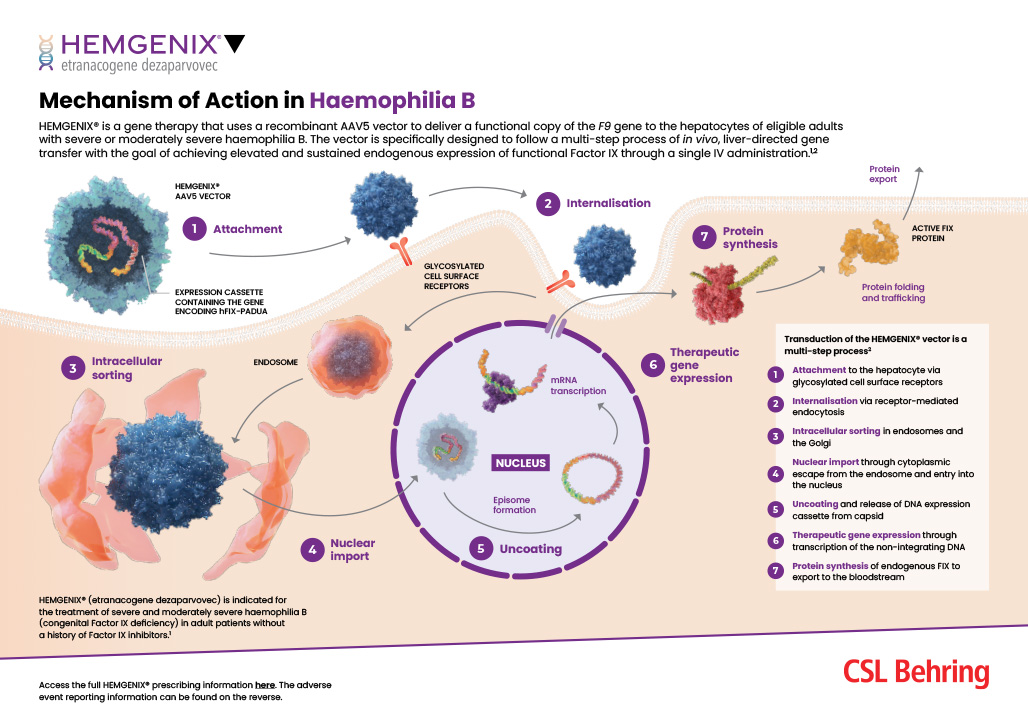
HEMGENIX® is an in vivo gene therapy that consists of a non-replicating recombinant adeno-associated viral vector serotype 5 (AAV5), containing the F9 gene variant encoding the gain-of-function Padua variant of the human FIX protein, under the control of a liver-specific promoter.1,7
HOPE-B was a multi-centre, multi-national, open-label, single-dose, single-arm, pivotal Phase 3 study. The objective was to determine efficacy and safety of HEMGENIX® in patients with severe or moderately severe haemophilia B.2
The following is a summary of the 5-year data taken from a pivotal Phase 3 study in which patients received a single infusion of HEMGENIX®.3
The primary endpoint compared ABR for all bleeds for non-inferiority between prophylaxis in the 6-month lead-in period and the 52 weeks following stable FIX expression (months 7–18) post-dosing of HEMGENIX®.2
HEMGENIX® IS A ONE-TIME INFUSION THAT OFFERS THE POTENTIAL FOR LONG-TERM BLEED PROTECTION, EVEN IN PATIENTS WITH PRE-EXISTING NAb TITRES OF UP TO 1:898‡1,3

ABR reduction in all bleeds during months 7–60 post-treatment compared with the 6-month lead-in period (n=54)#3
Primary endpoint: Comparing ABR for all bleeds for non-inferiority between prophylaxis in the 6-month lead-in period and the 52 weeks following stable FIX expression (months 7–18) post-dosing of HEMGENIX®.2

mean FIX activity sustained at 5 years (n=48)¶3
Secondary endpoint: FIX activity at 6, 12 and 18 months after dosing.2

of patients (51/54) free from FIX prophylaxis from months 7–60 post-treatment§3
Secondary endpoint: Proportion of patients remaining free of continuous prophylaxis.2

HEMGENIX® could be clinically effective even in eligible patients with pre-existing AAV5 NAbs (up to a NAb titre of 1:898 or equivalent)‡1,8
GUIDED TREATMENT JOURNEY FOR APPROPRIATE PATIENTS ON HEMGENIX®1
Monitoring requirements
For full information on monitoring after treatment with HEMGENIX®, please refer to the Summary of Product Characteristics.
After treatment with HEMGENIX®, it is recommended that a patient’s liver enzymes and FIX activity are monitored to follow the patient's response, as it may take several weeks for endogenous FIX levels to rise.1
Longer-term monitoring of ALT and FIX activity is recommended; however, these follow-up requirements decrease over time, depending on the patient’s FIX levels, their stability, and any evidence of bleeds.1


During follow-up, low reactive steroid use was reported in patients treated for elevations in early liver transaminases:3
- 16.7% of patients (9/54) received and discontinued corticosteroids**3
- for a mean (SD) duration of 81.4 (28.6) days (range 51–130 days)**3
Patients are expected to enrol in the follow-up study, in which their progress will be monitored for 15 years.1
GENE THERAPY FOR HAEMOPHILIA B EXPLAINED
Haemophilia B is a monogenic, X-linked genetic disorder that is suitable for gene therapy.2,5 Gene therapy for haemophilia B aims to increase clotting and FIX levels, respectively, by providing a functional gene or coding sequence, leading to improved health outcomes and reducing — or even possibly eliminating — the need for routine factor prophylaxis.2,7,9

For additional information,
please contact CSL Behring Medical Information at:
medinfo@cslbehring.com
5-year pivotal Phase 3 study; total of N=54 patients aged 19 to 75 years at enrolment with moderately severe or severe haemophilia B (FIX activity ≤2%) completed a 6-month observational lead-in period with standard-of-care routine FIX prophylaxis, after which patients received a single intravenous dose of HEMGENIX®. Post-treatment follow-up visits occurred regularly; 50/54 patients completed 60 months of follow-up.3
*Through 5 years of follow-up.
†Range 5.5–74.5%, n=48.
‡Patients with pre-existing anti-AAV5 NAbs were included in the HOPE-B clinical study. A pre-existing NAb titre above 1:898 may impede transgene expression at desired therapeutic levels and potentially reduce the efficacy of HEMGENIX® therapy. There are limited data in patients with NAbs above 1:678 (using a 7-point assay).1,2
§52/54 (96.3%) patients remained free of continuous regular FIX prophylaxis from day 21 to month 24 post-treatment. Between months 24–60, 1 patient returned to FIX prophylaxis and 1 patient did not respond to treatment (pre-existing AAV5 NAb titre of 1:3212).3
¶The mean ± SD (median; range) endogenous FIX activity level (i.e., in the absence of exogenous FIX exposure) of participants was 36.1 IU/dL ± 15.7 (35.45; 5.5, 74.5, n=48) at year 5 post-treatment.3,10
#ABR for all types of bleeds after stable FIX expression decreased from a mean of 4.19 for the lead-in period (all patients were under stable prophylaxis) to a mean of 1.51 (one-sided P=0.0002) at 7–18 months post-dose.1,2 At final analysis, there was a 63% reduction in ABR, from a mean of 4.16 during the lead-in period to a mean of 1.52 (P=0.0035) at months 7–60.3
||In patients with FIX activity >5 IU/dL; consider more frequent monitoring in patients with FIX activity levels ≤5 IU/dL and consider the stability of FIX levels and evidence of bleeding.1
**Safety population. All treatment-emergent ALT increases (n=13) were non-serious and resolved spontaneously or with a short course of corticosteroid treatment. Prophylactic corticosteroids to prevent ALT elevation are not required.1,3
AAV5, adeno-associated viral vector serotype 5; ABR, annualised bleeding rate; ALT, alanine aminotransferase; FIX, Factor IX; NAb, neutralising antibody; SD, standard deviation.
References
1. HEMGENIX® (etranacogene dezaparvovec). Summary of product characteristics. 2. Pipe SW et al. Gene Therapy with Etranacogene Dezaparvovec for Hemophilia B. N Engl J Med. 2023;388(8):706–718. 3. Pipe SW et al. Final Analysis of a Study of Etranacogene Dezaparvovec for Hemophilia B. N Engl J Med. 2026;394(5):463–474. 4. Miesbach W et al. How to discuss gene therapy for haemophilia? A patient and physician perspective. Haemophilia. 2019;25(4):545–557. 5. Pipe SW. Delivering on the promise of gene therapy for haemophilia. Haemophilia. 2021;27(Suppl 3):114–121. 6. National Institute for Health and Care Excellence (NICE). Technology appraisal guidance: Etranacogene dezaparvovec for treating moderately severe or severe haemophilia B. TA989. Published 24 July 2024. Available at: https://www.nice.org.uk/guidance/ta989. Accessed October 2026. 7. Perrin GQ et al. Update on clinical gene therapy for hemophilia. Blood. 2019;133(5):407–414. 8. Liu H et al. Validation of a cell-based transduction inhibition assay with an extended reportable range for measuring neutralizing antibodies to HEMGENIX®. CSL Behring. 2023;1–17. 9. Miesbach W et al. Gene therapy with adeno-associated virus vector 5-human factor IX in adults with hemophilia B. Blood. 2018;131(9):1022–1031. 10. Data on file: Study CSL222_3001 (HOPE-B): Final 5-year follow-up analysis. Database Extract Date: 30 April 2025.
Adverse Event Reporting
▼This medicine is subject to additional monitoring. Adverse events should be reported. Reporting forms and information can be found at www.mhra.gov.uk/yellowcard or search for MHRA Yellow Card in the Google Play or Apple store. Adverse events should also be reported to CSL Behring UK Ltd on 01444 447405 or medinfo@cslbehring.com.
